
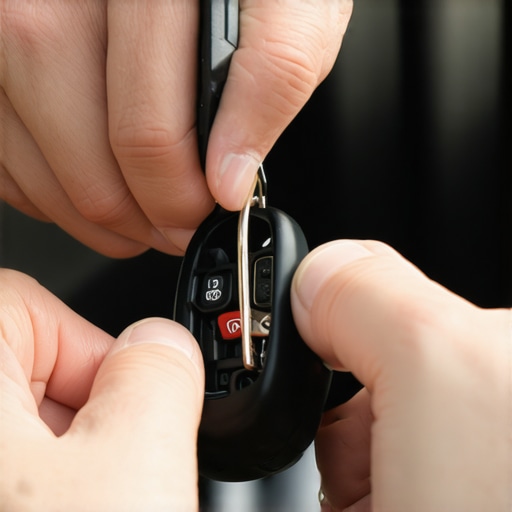
The Symptom of a Failing Digital Key
You press the button and nothing happens. You move closer to the driver side door, pressing again with more force as if physical pressure compensates for a dying lithium cell. It does not. As a locksmith with twenty-five years at the bench, I see this daily. People treat their key fobs like indestructible talismans, but inside that plastic shell is a delicate ecosystem of printed circuit boards, inductive coils, and a battery that is slowly losing its ability to push electrons through the circuit. Most folks make the mistake of taking a flathead screwdriver to the seam of the case, prying until the plastic burrs and the structural integrity of the water seal is compromised. You do not need to crack the case like a walnut to get the job done.
The Apprentice Lesson on Finesse
I teach my apprentices that if you have to force the key, you have to force the tool, or you have to force the case, you have already lost the battle. I remember a young lad named Miller who tried to muscle a stuck cylinder on a high security deadbolt. He ended up snapping a custom tension wrench and marring the face of a five hundred dollar architectural finish. Security is a game of tolerances. Whether you are dealing with a 6-pin tumbler system or a rolling-code transponder fob, the physics of the interface require precision, not power. When you feel resistance, that is the hardware telling you that your alignment is off. This principle applies perfectly to battery replacement. Most modern fobs from 2022 to 2026 models utilize a hidden tray or a specific leverage point accessible only when the mechanical emergency key is removed.
“Security is always a trade-off between convenience and protection.” – Industry Axiom
Mechanism Zooming: The Internal Physics of the Fob
Inside your fob, the battery (usually a CR2032 or CR1632) sits against a tensioned spring contact. This contact is often made of a nickel-plated copper alloy. Over time, vibration and humidity cause micro-corrosion at the contact point. When you swap the battery without cracking the case, you are usually sliding a tray out or using the emergency key blade as a lever against a specific internal shelf. This shelf is designed to distribute the load across the strongest part of the polymer housing, preventing the snapping of the tiny plastic tabs that hold the two halves together. If you break those tabs, your fob will never be water-resistant again, and the next rainstorm will fry the PCB. The PCB itself uses a surface-mount resonator and a microcontroller that generates a new code every time you press the button. This is the rolling code system, preventing replay attacks where a thief captures your signal to use later.
How to Swap the Battery Without Damage
First, locate the release switch for the mechanical override key. Slide the key out. Look inside the slot where the key was housed. You will see a small notch or a secondary slider. Use the tip of the mechanical key itself to catch this notch. Apply a steady, outward pressure. In many European and Japanese models, this will cause the battery carrier to pop out like a SIM card tray on a phone. No prying required. If your model requires the back plate to come off, use a plastic spudger, not metal. Metal tools cause gouges that act as stress concentrators, leading to cracks later. Once the tray is out, note the polarity. The positive side (marked with a plus sign) usually faces down toward the carrier bottom. Do not touch the flat surfaces of the new battery with your bare fingers. The oils from your skin contain salts that facilitate corrosion. Use a clean cloth or gloves.
Beyond the Fob: Rekeying After Burglary Best Practices
While a dead fob is an annoyance, a compromised home is a crisis. After a burglary, many homeowners think they need to replace every piece of hardware on the door. This is often a waste of money pushed by trunk slammers who want to sell you overpriced zinc hardware from a big box store. Rekeying vs replacing locks which is better? Rekeying is the process of changing the internal pins so the old key no longer works. It is more cost-effective and maintains the aesthetic of your original hardware. However, if the burglar used a pry bar and warped the door jam or the strike plate, replacement is mandatory. Best practices for 2026 involve moving away from standard 5-pin systems to anti-pick locks for front doors 2026 models that utilize sidebars and spool pins. A spool pin is a security pin that is thinned in the middle, designed to catch on the shear line and give the picker a false set, making it feel like the lock is open when it is actually trapped.
“The strength of a lock is not in its weight, but in the complexity of its shear line and the resilience of its materials.” – Locksmith Manual Vol. 4
The Physics of Perimeter Defense: Lock Shields and Deadbolts
If you are worried about physical attacks, look at lock shield installation for doors. A lock shield is a heavy-duty steel plate that wraps around the edge of the door, protecting the latch and the deadbolt from being retracted by a shim or a crowbar. For vacation homes, where a door might be left unmonitored for months, these are essential. You should also consider commercial smart access control 2026 trends, even for residential use. This includes access logs for smart locks. Knowing exactly when a code was entered allows you to track cleaners, guests, or potential intruders. A deadbolt is only as strong as its strike plate. Most builders use half-inch screws that only grab the pine casing of the door. I tell my customers to toss those out and use three-inch hardened steel screws that bite directly into the wall studs. This transforms the door from a flimsy barrier into a structural part of the house.
Smart Home Security Integration 2026
The future of security is the integration of mechanical reliability with digital oversight. Smart home security integration 2026 means your deadbolt communicates with your cameras and lighting. If a broken key extraction tool is used on your cylinder, the vibration sensors can trigger a notification. Broken key extraction tools 2026 reviews show that even the best stainless steel extractors struggle with high-security restricted keyways. This is why key control is vital. If you have a restricted keyway, no one can take your key to a kiosk and get a copy made. You are the only one who can authorize a duplicate. This is the ultimate defense against employee theft in commercial settings or untrustworthy contractors in residential ones.
Proper Maintenance: The Graphite vs WD-40 Myth
I cannot end this without addressing the biggest crime in the locksmith world: spraying WD-40 into a lock cylinder. WD-40 is a solvent and a degreaser, not a long-term lubricant. It will feel good for a week, but then it will attract dust and grime, turning into a sticky paste that freezes the pins in their chambers. If your key is sticky, use a dry PTFE spray or a high-grade graphite. However, be careful with graphite in electronic locks, as it is conductive and can short out the sensors. For modern smart locks, a tiny bit of synthetic grease on the actuator is all you need. Keep your hardware clean, keep your batteries fresh, and stop prying at things with screwdrivers. Security is about the details, and the details start with how you treat the tools in your pocket. If you are in an area with high humidity or coastal salt air, your locks will oxidize faster. Check the movement of your deadbolt every six months. If it does not slide like a hot knife through butter, it is time for a professional to look at the alignment. A misaligned lock is a lock waiting to fail at the worst possible moment.”, “image”: {“imagePrompt”: “A close-up, high-detail macro shot of a master locksmith’s weathered hands using a professional plastic spudger to gently slide a battery tray out of a modern 2026 automotive key fob. The background shows a blurry locksmith bench with brass key shavings, a disassembled deadbolt, and a professional Lishi picking tool. The lighting is moody and industrial, highlighting the textures of the plastic and the metal.”, “imageTitle”: “Professional Key Fob Battery Replacement Technique”, “imageAlt”: “Locksmith replacing a key fob battery using a tray ejection method instead of prying the case open.”}, “categoryId”: 0, “postTime”: “”}
Comments are closed.