
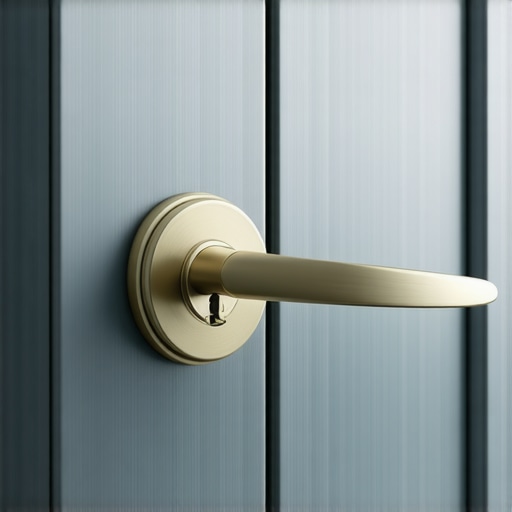
The Hard Lesson of the Apprentice and the Shear Line
I teach my apprentices that if you have to force the key, you’ve already lost. It is a lesson I have repeated for over two decades in my shop. I remember a kid named Mike who thought he could muscle a stuck plug in a commercial mortise cylinder. He snapped a nickel-silver key clean off because he didn’t understand the physics of the shear line. A lock is a mechanical computer. If the variables—the pin heights—don’t match the code on the key, the logic gate stays closed. In the world of commercial security, especially when we talk about the invisible benefit of commercial restricted keyways, that logic gate is protected not just by metal, but by federal patent law. Most business owners think a lock is just a lock. They are wrong. A standard lock is a suggestion. A restricted keyway is a legal and physical barrier that prevents the most common security breach in the world: the unauthorized duplicate key. When you buy a cheap cylinder from a big box store, you are buying hardware that any teenager at a kiosk can copy in ninety seconds. That is not security. That is an invitation.
“Security is always a trade-off between convenience and protection.” – Industry Axiom
The Physics of High-Security Mechanism Zooming
To understand why commercial panic exit devices 2026 and restricted cylinders are superior, you have to look at the internal physics. Standard residential pins are smooth cylinders. In high-security restricted systems, we use spool pins, mushroom pins, and serrated drivers. These are designed to catch on the shear line if someone tries to pick or bump the lock. But the real ‘invisible’ benefit is the paracentric keyway and the sidebar. A restricted keyway is milled with such complex geometry that standard picking tools cannot even reach the pins. Furthermore, many of these systems utilize a sidebar. This is a secondary locking mechanism that requires the key to not only lift the pins to the correct height but also rotate them to a specific angle or interact with a secondary set of sliders. When you are looking at affordable biometric door hardware or residential keypad locks reviews, you are often looking at convenience. But for a commercial facility, you need the raw mechanical resistance of a restricted system. The key blanks for these systems are not sold to the public. They are not even sold to every locksmith. I have to maintain a specific license and contract with the manufacturer to even hold the blanks for certain restricted profiles. This means if an employee takes their key to a hardware store, the machine literally cannot grip the key, and the store cannot buy the blank. That is true key control.
The Evolution of Panic Hardware for Office Buildings 2026
As we move into the 2026 standards, the requirements for fire-rated panic hardware options are becoming more stringent. It is not just about getting people out; it is about ensuring the door remains a fire barrier while under extreme thermal stress. When I install commercial panic exit devices 2026, I am looking at the metallurgical composition of the latch bolt. We are seeing a shift away from zinc-based alloys toward stainless steel and investment-cast steel. Why? Because in a fire, zinc melts at a relatively low temperature. If your latch melts, the fire door swings open, the draft feeds the flames, and the building burns faster. A fire-rated device must withstand the ‘hose stream’ test, where the hardware is heated to 1900 degrees and then blasted with a high-pressure fire hose. If the hardware shears or the door opens, it fails. This is why you cannot use ‘cheap’ hardware on a commercial exit. You need the grade 1 certification. I often tell building managers that the cost of the hardware is an insurance policy. If you install sub-par devices, you are liable when that door fails during a routine inspection or, heaven forbid, an actual emergency.
“Standardized testing ensures that hardware can withstand both the elements and the intentional force of an intruder.” – ANSI/BHMA Overview
Modern Challenges: From Tesla Lockouts to Airbnb Security
My shop has seen it all, from emergency safe cracking services for 100-year-old floor safes to car lockout services for Tesla models. People think that because a Tesla uses a card or a phone, it is ‘unhackable.’ But physics still applies. When the 12V battery dies, you are locked out. Knowing what to do when locked out of your car in 2026 involves more than just a slim jim. In fact, if you use a slim jim on a modern vehicle, you will likely rip the wiring harness for the side-impact airbags. We use air wedges and long-reach tools that bypass the electronics to hit the mechanical manual release inside the cabin. The same logic applies to electronic locks for Airbnb properties. These are great for rotating codes, but the mechanical override is usually a bottom-tier 5-pin SC1 cylinder that any amateur can rake open in five seconds. I always recommend my clients pair their smart locks with a high-quality deadbolt on a restricted keyway if they are leaving the property vacant for long periods. The humidity in our region can also cause door frames to swell, which puts lateral pressure on the motor of a smart lock. If the bolt cannot extend fully, the ‘locked’ signal sent to your phone is a lie. The motor thinks it is locked, but the bolt is jammed against the strike plate. I have seen countless ‘secure’ properties where the door was actually standing open because of a simple 1/8 inch alignment issue.
The Scam Buster: Why the $29 Service Call is a Lie
I see it every week. A customer comes into my shop with a drilled-out lock, complaining that a ‘locksmith’ they found online charged them five hundred dollars. This is the ‘Trunk Slammer’ special. They advertise a $15 or $29 service call to get you to hang up the phone. When they arrive, they don’t even try to pick the lock. They don’t use a Lishi tool or a pick gun. They pull out a drill, destroy your cylinder, and then sell you a replacement lock that is ten times worse than the one they destroyed. A real master locksmith values the ‘non-destructive entry.’ My goal is to get you in without a scratch. Whether it is a mobile app locksmith booking 2026 or a traditional phone call, you need to ask if they are a licensed brick-and-mortar shop. If they don’t know what a ‘restricted keyway’ is or they can’t explain the difference between a grade 1 and grade 3 deadbolt, send them away. Security involves trust, not just metal. When I perform emergency safe cracking services, I use a scope to see the internal wheels of the dial. I don’t just go at it with a sledgehammer. There is a craft to this, a respect for the engineering that went into the safe. If you have a high-value asset, you don’t want a hacker; you want a technician who understands the material science of the barrier they are trying to bypass.
Maintenance and the Myth of Graphite
I will leave you with a piece of bench wisdom. Stop putting graphite in your locks. People think it is a miracle lubricant, but in high-traffic commercial environments, graphite mixes with the oil from your skin and the dust in the air to create a thick paste. This paste eventually gums up the tiny springs behind your pins, leading to a ‘sticky’ lock that eventually fails to turn. For restricted keyways and high-end hardware, use a synthetic PTFE-based lubricant. It goes on wet, cleans out the debris, and leaves a dry film that doesn’t attract gunk. Also, check your strike plates. If your door is sagging, the latch isn’t hitting the hole correctly. This puts stress on the entire locking mechanism. A simple three-inch screw into the top hinge can often pull the door back into alignment and save you a four-hundred-dollar service call. Security isn’t a product you buy once; it is a state of mechanical readiness that requires regular attention and professional-grade hardware.”,”image”:{“imagePrompt”:”A close-up, high-detail macro shot of a nickel-silver restricted key being inserted into a high-security commercial cylinder. The focus is on the intricate side-millings and the solid brass construction of the lock face. Professional lighting, locksmith workbench background.”,”imageTitle”:”High-Security Restricted Keyway Close-up”,”imageAlt”:”A master locksmith inserting a patented restricted key into a commercial grade 1 lock cylinder.”},”categoryId”:0,”postTime”:””}