
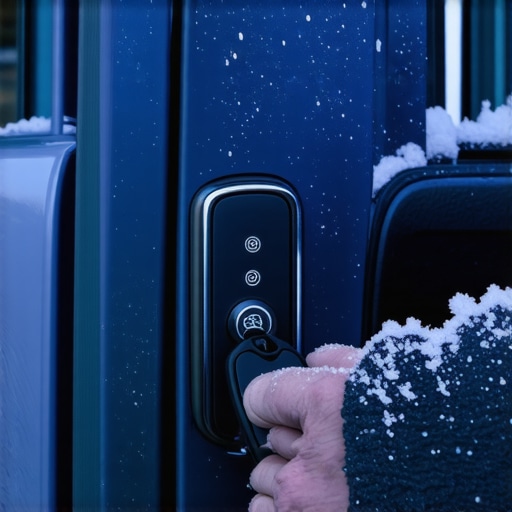
I teach my apprentices that if you have to force the key, you have already lost. That technical wisdom usually applies to a brass blade inside a pin tumbler cylinder, but in the world of Electric Vehicles (EVs) and high-end automotive security, the logic remains identical. When a customer stands in a frozen driveway staring at a high-tech car that refuses to recognize their presence, they are dealing with a physics failure, not a software bug. As a locksmith with over 25 years at the bench, I see this every time the thermometer drops below freezing. The transition from physical metal to digital handshakes has not removed the vulnerabilities of the trade; it has merely changed the medium from mechanical shear lines to electromagnetic signals.
“Security is always a trade-off between convenience and protection.” – Industry Axiom
The Forensic Autopsy of a Cold Weather Failure
The symptom is always the same: a silent vehicle. You approach with your fob, or perhaps your smartphone via Bluetooth Low Energy (BLE), and the handles stay flush. There is no chirp, no light flash, just a cold piece of expensive machinery. To understand why this happens, we have to look at the material science of the keyless entry system. The primary culprit is the electrochemical state of the Lithium-Ion cells within your key fob. Most modern fobs rely on a CR2032 or CR2035 coin cell battery. These batteries use a liquid electrolyte to move ions between the anode and the cathode. When the temperature plummet, the viscosity of that electrolyte increases, which significantly raises the internal resistance of the battery. This means the battery cannot provide the sudden burst of current required to broadcast the 315MHz or 433MHz rolling code signal to the car’s Engine Control Unit (ECU).
Furthermore, the door sensors themselves are often capacitive. They work by detecting the electrical change when your hand approaches the handle. In extreme cold or high humidity, a thin layer of frost or ice can act as a dielectric insulator, effectively masking your hand’s electrical signature from the sensor. This is why we are seeing a shift in the locksmith tools market outlook 2026 toward more sophisticated diagnostic readers that can bypass these environmental blockers. If the car cannot see the fob and the handle cannot feel your hand, the digital door remains barred. This leads many to wonder about the cost of hiring a professional locksmith in 2026, especially as vehicles become more like computers on wheels. A real professional uses tools like a Lishi pick for the hidden emergency lock cylinder rather than reaching for a drill like a trunk-slamming scammer would.
The Hidden Mechanical Fail-Safe
Every EV has a secret. Underneath that sleek, aerodynamic plastic cap on the driver’s side handle is almost always a physical lock cylinder. When the electronic access control systems for small businesses or residential EVs fail, this is your entry point. However, because these cylinders are rarely used, they are prone to seizing. The internal wafers, which are often made of a cheaper zinc alloy in modern production to save weight, can corrode or become stuck due to moisture ingress that freezes solid. I have seen countless cases where a broken key extraction tools 2026 reviews list would have been useful because a frustrated owner tried to force a metal key into a frozen lock. If you have to force it, the ice has already won.
“In high-security applications, the integrity of the physical barrier is only as strong as its weakest electronic component.” – Security Standards Manual
We must also discuss the 12V lead-acid or lithium auxiliary battery found in EVs. While the massive traction battery powers the wheels, it is a smaller 12V battery that runs the security system and the wireless receivers. If this battery is weakened by the cold, the car goes into a deep sleep to preserve its remaining voltage. In this state, the car literally stops listening for your key. This is a common service call for those of us in the emergency locksmith growth trends 2026 sector. We see people who think their car is dead, but it is actually just deaf. For business key management software users, this can be a nightmare for fleet operations during a winter storm.
How to Prevent Future House Lockouts and Vehicle Lockouts
The best way to manage these risks is through proactive maintenance. Just as you might look into door reinforcement for security at home or install anti-pick locks for front doors 2026, you must treat your vehicle security with the same technical respect. First, replace your fob battery every autumn regardless of its current charge. Second, use a high-quality synthetic lubricant (never graphite in a car door) for the hidden mechanical cylinder. This prevents moisture from taking hold. For those also worried about their property, home safe lockout recovery often involves similar issues with electronic keypads failing in unheated garages or outer buildings. The logic of the cold is universal: it drains power and seizes movement.
The Technical Action Plan
If you find yourself locked out of your EV in the cold, do not call a scammer who arrives with a drill. A professional locksmith will first attempt to warm the lock cylinder using a heat pack to melt internal ice. We then check the signal strength of your fob using a frequency counter. If the fob is dead, we can often use an inductive loop to power the start button or the entry sensor. This is a far cry from the $29 bait and switch specialists who only know how to destroy hardware. Security is about understanding the physics of the barrier. Whether it is a Grade 1 deadbolt or a Tesla Model 3, the goal is non-destructive entry. Proper security involves trust and technical mastery, not just a toolbox full of destructive implements.