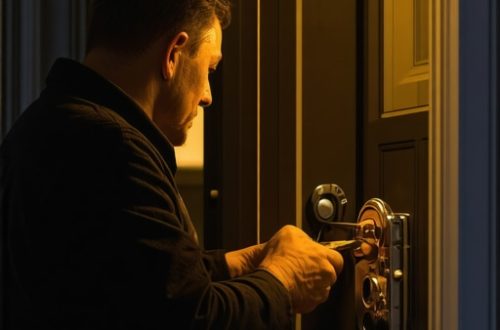
![4 Pro Home Safe Lockout Recovery Fixes [2026 Money Savers]](https://prolocksmithco.com/wp-content/uploads/2026/04/4-Pro-Home-Safe-Lockout-Recovery-Fixes-2026-Money-Savers.jpeg)
The Anatomy of a Failed Safe: A Master Locksmith Perspective
I see it every Tuesday. A customer walks into my shop with a heavy metal box and a look of pure frustration. Just last week, a lady came into my shop crying because a scammer drilled her fire safe and charged her five hundred dollars for a ten minute job that destroyed the unit. She had her birth certificates and her grandmother’s jewelry trapped inside, and the trunk slammer she found online used a cordless drill and a masonry bit like he was mounting a television. He didn’t even know what a relocker was. That is why I am writing this. You do not always need a drill, and you certainly do not need a scammer. When a safe fails, it is usually a physics problem or a power problem, not a mystery. Most home safes today use either a digital solenoid or a mechanical dial with a three wheel pack. Understanding the material science of these units, specifically the difference between brass components and the cheap zinc alloy found in big box stores, is the first step in recovery.
“Security is always a trade-off between convenience and protection.” – Industry Axiom
Fix 1: The Solenoid Percussion Method (The Digital Bounce)
If you have a digital keypad safe and you hear a faint click but the handle won’t turn, you are likely dealing with a stuck solenoid. Inside the door, a small electromagnetic coil pulls a pin back to allow the bolt work to move. Over time, the cheap grease used in manufacturing can dry out or the safe can be overstuffed, putting lateral pressure on the bolt. This friction is the enemy. To fix this without a drill, apply firm pressure to the door, pushing it closed as tightly as possible to relieve the pressure on the bolt. While holding it, enter your code. At the exact moment the solenoid clicks, give the door a firm strike with the palm of your hand near the keypad. This vibration can jar the solenoid pin loose. If this fails, check your power. High security euro cylinder locks and smart locks often fail because people use generic batteries. In 2026, digital safes require high amperage output. Use only premium lithium batteries. If your safe has external terminals, use a fresh nine volt battery and wait sixty seconds for the capacitors to charge before entering the code.
Fix 2: Manipulation and the Fly (Mechanical Dials)
Mechanical safes use a series of wheels with notches called gates. When the gates align, a fence drops into the channel and the safe opens. If your dial is spinning freely or feels gritty, the fly, which is the small part that allows the wheels to pick each other up, might be damaged. Before calling for 24/7 emergency locksmith services explained in your local directory, try a reset. Spin the dial ten times to the left to clear the wheels. If the dial feels stiff, the humidity in places like Florida or the coast can cause the metal to expand. In my shop, I teach apprentices that if you have to force the key or the dial, you have already lost. For a mechanical lockout, try the “overshoot” technique. Sometimes the brass dial expands just enough that the numbers on the index line are slightly off. Try your combination one half increment higher or lower than your standard numbers. This accounts for the mechanical wear on the drive cam and the fence.
Fix 3: The Emergency Keyway Bypass
Many digital safes sold in 2026 include a hidden override key. This is usually behind a plastic plate or the keypad itself. The problem is that these locks are often low grade wafer tumblers that are prone to oxidation. If you have the key but it will not turn, do not use WD-40. That is a myth that ruins locks by attracting dust and forming a sticky paste. Use a dry PTFE or graphite lubricant. Insert the key and gently tap the back of it with a screwdriver handle. This sends a shockwave through the wafers, which can help them move past the shear line if they are stuck due to lack of use. This is a common issue in 24/7 mobile locksmith for apartments calls where safes sit in closets for years. If the key is lost, a professional locksmith can use a Lishi tool to decode the wafers without damage, which is a far better alternative than drilling.
“The strength of a lock is only as good as the technician’s understanding of its failure points.” – Locksmith Security Manual
Fix 4: External Override and Smart Lock Hacking Prevention Tips
If your safe is a modern smart safe, the lockout might be software-based. Many safes now link to home security systems. If you are locked out, check your hub for firmware updates. Some 2026 models can be triggered into a lockout mode if they detect a low-frequency vibration that mimics a drill. If your safe has a micro-USB port at the bottom, this is not just for power. It is a diagnostic port. Connect a laptop or the manufacturer’s mobile app to see if a lockout timer has been activated. To prevent this in the future, follow smart lock hacking prevention tips like changing your master code every six months and ensuring your safe is not on a public Wi-Fi band. If you are looking to upgrade your home security on a budget, investing in a safe with a secondary mechanical override is the best money you can spend. It avoids the high EV car key fob replacement costs 2026 or specialized keyless ignition repair services rates if you were to lose digital access entirely.
The Forensic Verdict: Repair or Replace?
Once you get the safe open, you must decide if it is still a security tool or just a heavy box. If the solenoid failed, it will fail again. If the mechanical dial has a flat spot on the drive cam, it is compromised. In my 25 years of bench experience, I have seen too many people put their trust in zinc hardware that has reached its fatigue limit. If you are in a high humidity area, your lock components will corrode faster than you think. Always check your strike plates and bolt work for signs of metal shaving. A healthy safe should operate with a smooth, metallic click. If it sounds like grinding sand, you are headed for another lockout. For those in commercial settings, look into interchangeable cores (IC) or touchless entry systems for offices to avoid these residential pitfalls. Remember, a real locksmith is a technician of physics, and a drill is always the last resort, never the first tool out of the bag. Keep your hinges greased, your batteries fresh, and your combination written in a secure, off-site location.

![4 Pro Home Safe Lockout Recovery Fixes [2026 Money Savers]](https://prolocksmithco.com/wp-content/uploads/2026/04/4-Pro-Home-Safe-Lockout-Recovery-Fixes-2026-Money-Savers-1-75x75.jpeg)

![4 Pro Home Safe Lockout Recovery Fixes [2026 Money Savers]](https://prolocksmithco.com/wp-content/uploads/2026/04/4-Pro-Home-Safe-Lockout-Recovery-Fixes-2026-Money-Savers-1-500x330.jpeg)