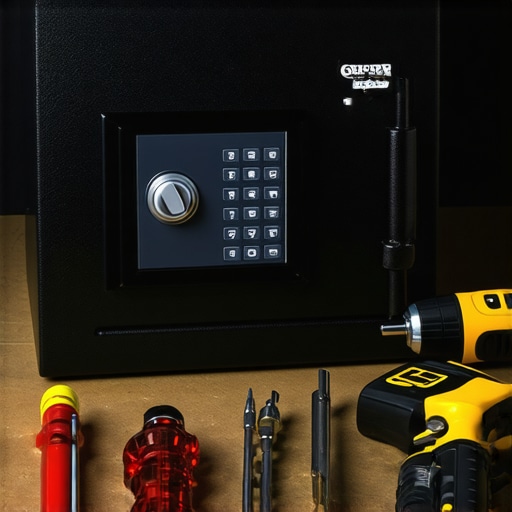
The Apprentice Lesson: Why Force is the Enemy of Physics
I teach my apprentices that if you have to force the key or the dial, you’ve already lost the battle against the physics of the lock. I’ve seen it a thousand times in my shop: a frustrated homeowner tries to ‘persuade’ a stuck safe handle with a rubber mallet, only to trigger the internal relockers. Now, instead of a simple service call, they’re looking at a multi-hour surgical operation involving carbide drill bits and a borescope. A safe isn’t just a box; it’s a series of balanced mechanical or digital gates. When you understand that security is a physics problem, you realize that speed in safe recovery isn’t about strength—it’s about diagnostics. In 2026, we are seeing a massive influx of fingerprint lock reliability tests failing because people buy cheap zinc-alloy units from big-box retailers. These ‘bargain’ safes use low-grade solenoids that fatigue after just a few hundred cycles. If you’re staring at a dead keypad, don’t reach for the hammer. Reach for the logic of the mechanism.
“Security is always a trade-off between convenience and protection.” – Industry Axiom
Tactic 1: The Electronic Pulse and Keypad Diagnostics
The most common 2026 residential lockout involves the failure of the digital interface. Most modern safes use a solenoid-driven locking bolt. When you enter your code, a capacitor discharge sends a pulse to an electromagnet that pulls a pin, allowing the handle to turn. If you hear a weak ‘click’ but the handle won’t budge, your voltage is likely too low to overcome the friction on the bolt work. This is where key fob battery replacement guide logic comes into play; people assume any 9V battery works, but cheap carbon-zinc batteries lack the amperage to fire a high-security solenoid. Use a fresh lithium-ion cell. If the keypad is totally unresponsive, we look at the ‘handshake’ between the reader and the control board. In 2026, commercial smart access control trends have pushed home safes toward encrypted signals. If the wiring is pinched in the door hinge, the signal is lost. I often use a diagnostic jumper to bypass the external keypad and talk directly to the solenoid—this is a non-destructive recovery tactic that saves the safe and your sanity.
Tactic 2: Overriding the Biometric Failure
We are seeing more solar-powered smart locks 2026 models hitting the market, some even integrated into home safes. While eco-friendly, they often struggle with capacitance in humid environments. If your fingerprint lock fails its reliability test during a lockout, the first step is cleaning the sensor with isopropyl alcohol. Sweat oils can build up, creating a ‘ghost’ image that prevents a clean read. If that fails, look for the hidden mechanical override. Many homeowners forget that beneath that high-tech plastic shroud is a standard wafer or pin-tumbler lock. This brings up the age-old debate of rekeying vs replacing locks which is better. If you’ve lost the override key, I can usually perform a broken key extraction or use a Lishi pick to decode the cylinder without a single scratch to the finish. This is why I tell people to avoid ‘Trunk Slammer’ locksmiths who immediately reach for the drill; a pro knows how to talk to the pins.
“The strength of a system is only as good as its weakest link, which is often the interface between the user and the mechanism.” – Security Manual 101
Tactic 3: Managing the Mechanical Stall and Bolt Pressure
Sometimes the electronics are fine, but the physics of the door are against you. Overstuffed safes are the primary cause of mechanical stalls. If you have papers or a stray velvet jewelry box pressing against the back of the door, it puts ‘side-load’ pressure on the locking bolts. This friction is often greater than the motor or solenoid can handle. To recover from this, you must push in on the door while entering your code or turning the dial. This relieves the friction on the shear line of the bolt, allowing it to retract freely. We see this often in emergency residential lockout solutions. If the bolt is actually jammed due to a component failure, we use broken key extraction tools 2026 reviews to identify if there’s debris in the keyway or if a spring has snapped. In 2026, high-tech lock bumping prevention is standard, meaning you can’t just ‘jar’ these open like the old days. You need to understand the internal tolerances.
The Forensic Verdict on 2026 Security
Whether you are dealing with preventing bike lockouts with smart tech or a high-end jewelry safe, the principles remain the same: maintenance beats emergency repair every time. If your safe handle feels ‘crunchy,’ it’s the brass bushings wearing down or the factory grease turning into sandpaper. Don’t use WD-40; it attracts dust and turns into a sticky mess that will eventually seize your tumblers. Use a dry PTFE lubricant. If you find yourself truly stuck, mobile app locksmith booking 2026 services can get a tech to you, but make sure they are a licensed shop with a real bench. Real security involves trust and metal, not just a flashy app. Your safe is a precision instrument; treat it like one, and it won’t lock you out when the clock is ticking.

![Is Someone Picking Your Lock? 4 Hidden Tampering Signs [2026]](https://prolocksmithco.com/wp-content/uploads/2026/02/Is-Someone-Picking-Your-Lock-4-Hidden-Tampering-Signs-2026-75x75.jpeg)


I really appreciate the emphasis on understanding the mechanics and physics behind safes rather than brute force approaches. I’ve seen many cases where homeowners, in panic, try to force the handle or bang on the safe, which often causes more damage or triggers relockers. Your point about low-grade solenoids wearing out quickly is especially relevant now, considering how many affordable safes from big-box stores use such components. In my experience, regular maintenance, like lubricating moving parts with appropriate lubricants, can prevent many lockout issues. The suggestion to push inward while entering the code during a stall is something I always recommend to clients, as it often relieves side-load pressure and allows the lock to retract smoothly. From your perspective, what are some signs that a safe is approaching the point of needing a professional diagnostic before total failure? I think proactive measures can save time and money in the long run.