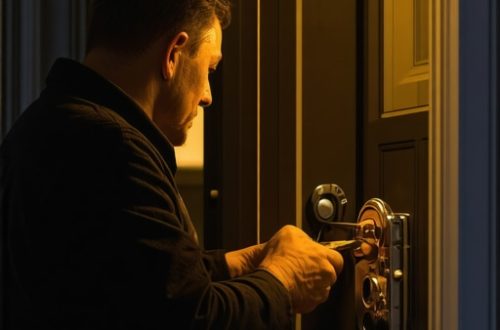
![Locked Out of Your Car? 4 Fast Ways to Get Back Inside [2026]](https://prolocksmithco.com/wp-content/uploads/2026/03/Locked-Out-of-Your-Car-4-Fast-Ways-to-Get-Back-Inside-2026.jpeg)
Locked Out of Your Car? 4 Fast Ways to Get Back Inside [2026]
I once had a customer call me at 3 AM because he was stranded in a torrential downpour outside a gas station, his keys mocking him from the center console of his 2024 pickup. He’d already tried to use a wire coat hanger he found in a trash can, and all he’d managed to do was shred his weather stripping and scratch the paint down to the primer. He was desperate, soaked, and about five minutes away from throwing a brick through his own window. I told him to put the brick down. In 25 years of running my own shop, I’ve seen every ‘life hack’ in the book, and most of them are just expensive ways to turn a simple lockout into a $1,200 body shop bill. If you’re standing there right now, looking at your keys through the glass, stop. You need to understand the physics of what you’re dealing with before you ruin a high-security entry system.
“Security is always a trade-off between convenience and protection.” – Security Axiom
The Mechanics of Modern Automotive Entry
Modern cars aren’t the simple mechanical puzzles they were in the 90s. Back then, you could manipulate a lazy vertical linkage with a slim jim. Today, we’re dealing with shielded cables, recessed lock cylinders, and electronic deadlocks that make those old tools obsolete. When you press the button on your fob, you aren’t just moving a piece of metal; you’re initiating a rolling code handshake between your key’s transponder and the vehicle’s Engine Control Unit (ECU). If you try to force the physical lock without understanding the wafer configuration, you risk triggering an immobilizer state that could require a full dealer reset. We use Mechanism Zooming to look at the internal physics: inside your door lock is a series of wafers—small flat plates of brass or stainless steel. Each wafer is spring-loaded and must be lifted to a specific height to clear the shear line. If even one wafer is off by half a millimeter, the plug won’t turn. This is precision engineering, not a brute force challenge.
1. The Professional Air Wedge and Reach Method
The most common non-destructive entry involves an air wedge and a long-reach tool, but there is a science to it. We use a ballistic nylon bag that is incredibly thin when deflated. We slip it into the upper corner of the door frame. By slowly pumping air into the bag, we create a microscopic gap—just enough to slide a coated memory-flex rod inside. The danger here is ‘over-wedging.’ If you pump that bag too hard, you’ll spring the door frame, and it will never whistle-free again at highway speeds. You have to understand the tensile strength of the steel frame. Once inside, we aim for the internal manual lock flipper or the door handle itself. However, many 2026 models now feature ‘double-lock’ logic where the internal handles are disconnected when the car is armed. This is where car remote programming tutorials and professional software come into play to pulse the CAN-bus system.
2. Lishi Decoding: The Surgical Strike
If the air wedge isn’t an option—perhaps because of side-curtain airbags or reinforced frames—we go to the Lishi tool. This is the gold standard for master locksmiths. A Lishi tool is both a pick and a decoder. It slides into the keyway and allows us to feel the individual spring tension of each wafer. High-tech lock bumping prevention has made standard bump keys useless, but a Lishi allows us to read the depths of the lock. I can tell you exactly what the ‘bitting’ of your key is just by feeling the resistance of the wafers. Once decoded, we don’t just ‘pick’ it; we actually know the key’s DNA. This is essential for biometric keyless entry for cars where a physical override is hidden behind a plastic cap. We aren’t just guessing; we are interacting with the internal physics of the cylinder.
“The integrity of a locking system is only as strong as its weakest physical component, often the cylinder plug itself.” – ANSI/BHMA Standard Logic
3. Transponder and ECU Handshaking
Sometimes you aren’t locked out because you lost your keys, but because the car ‘forgot’ them. This happens frequently with electronic gate lock systems and automotive transponders during battery surges. In 2026, the rolling code algorithms are more complex. If your fob isn’t responding, it’s often a desynchronization of the hopping code. As a professional, I connect a diagnostic tablet to your OBD-II port to ‘re-introduce’ your key to the car. This isn’t something you can do with a YouTube tutorial. You need a licensed locksmith who has the encryption tokens to talk to the manufacturer’s server. This is the same level of security used in commercial master key system advantages for businesses, ensuring that no unauthorized duplicate can ever start the engine.
4. Avoiding the ‘Trunk Slammer’ Scam
This is where I get grumpy. You search for a locksmith and see a ‘$29 Service Call’ ad. That is a bait-and-switch. A real locksmith with a brick-and-mortar shop and 25 years of experience isn’t driving to your location at 2 AM for thirty bucks. Those scammers show up in an unmarked car, tell you the lock is ‘high security,’ and immediately pull out a drill. They destroy your lock, charge you $500 for a $20 replacement made of cheap zinc, and leave you with a car that won’t start. A real pro uses lock shield installation for doors techniques to protect the mechanism, not destroy it. If they don’t ask for your ID and registration before they start, they aren’t a pro—they’re a liability. Always vet your tech. If they don’t know the difference between a side-milled track and a standard edge-cut key, send them packing.
The Maintenance of Security
Whether you’re managing multi-family building lock rekeying or just trying to get into your sedan, the principles are the same: respect the hardware. Don’t spray WD-40 into your lock cylinders; it attracts grit and turns into a sticky paste that jams wafers. Use a dry PTFE lubricant or high-grade graphite. If you’re looking at best residential door locks for safety and durability, or even smart locks for pet doors, the physical cylinder is always the point of failure. Keep it clean, keep it lubricated, and for heaven’s sake, have a spare key made before you need one. We provide locksmith services for vacation homes where people often lose keys in remote areas—having a hide-a-key transponder (hidden in a signal-blocking pouch) can save you a thousand-dollar towing bill.

![3 Reasons Your EV Keyless Entry Is Failing in 2026 [Fixed]](https://prolocksmithco.com/wp-content/uploads/2026/03/3-Reasons-Your-EV-Keyless-Entry-Is-Failing-in-2026-Fixed-75x75.jpeg)