![Snapped Key? 3 Tools to Extract It Without Ruining Your Lock [2026]](https://prolocksmithco.com/wp-content/uploads/2026/04/Snapped-Key-3-Tools-to-Extract-It-Without-Ruining-Your-Lock-2026.jpeg)
The Anatomy of a Snap: Why Metal Fails Under Pressure
I teach my apprentices that if you have to force the key, you’ve already lost the battle before it even started. Most people think a key is a solid piece of indestructible metal, but in reality, it is a precision instrument subjected to thousands of cycles of torque and tension. When you feel that sickening ‘thud’ followed by a light ‘clink’ on the pavement, you aren’t just looking at a broken piece of brass; you are looking at a failure of material science. Most modern keys are made of nickel-silver or brass, but the cheap blanks found at big-box hardware stores are often filled with zinc or ‘pot metal.’ Over time, microscopic stress fractures develop at the deepest cuts in the key profile, which we call the ‘root depth.’ In 2026, with the rise of affordable biometric door hardware and smart deadbolts with fingerprint scanners, the traditional mechanical key is often relegated to a backup role, meaning it sits in a pocket or purse accumulating damage until the one moment you actually need it, then it snaps right at the face of the cylinder plug.
“Security is always a trade-off between convenience and protection.” – Industry Axiom
The physics of the situation are simple but brutal. The broken blade of the key is currently trapped behind the pins. Inside that cylinder, you have a series of five or six pin stacks. Each stack consists of a bottom pin, a driver pin, and a spring. When the key snaps, the springs are pushing the driver pins down, pinning the broken key fragment against the bottom of the keyway. If the snap happened while you were turning the lock, the ‘shear line’ is misaligned, meaning the plug is trapped in a rotated position, locking the fragment in a mechanical vise. This is where most homeowners make their first mistake: they reach for a pair of needle-nose pliers or, heaven forbid, a tube of superglue. If you try to glue the head of the key back onto the fragment, you will almost certainly migrate that adhesive into the pin chambers, effectively welding your lock into a permanent paperweight. This leads to door lock jamming fixes 2026 that cost hundreds of dollars instead of a simple extraction fee.
Tool 1: The Spiral Extractor (The Surgeon’s Needle)
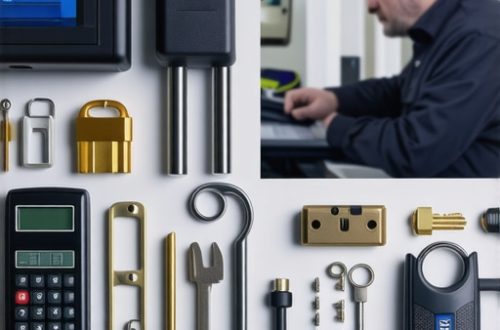
The first tool in any real locksmith’s kit for this job is the spiral extractor. This isn’t a hardware store item; it’s a specialized piece of high-carbon steel with a corkscrew-like thread. When we look at mechanism zooming, we see that even a broken key has ‘valleys’ or ‘bittings.’ The spiral extractor is designed to slide into the narrow gap between the side of the keyway and the key fragment itself. You don’t just shove it in. You have to feel for the ‘warding’ of the lock. Once the tool is past the first or second pin, you give it a slight clockwise turn. The microscopic barbs on the spiral tool bite into the softer brass of the key fragment. As you pull back with a steady, even pressure, the tool drags the fragment past the pin stacks. This requires a tactile ‘read’ of the spring tension. If the fragment is bound too tightly, you might need to use a secondary probe to lift the first pin stack slightly, relieving the downward pressure and allowing the fragment to slide out without scarring the internal cylinder walls.
Tool 2: The Hooked Saw-Blade Extractor (The Mechanical Barb)
When a spiral extractor can’t get a grip, we move to the hooked saw-blade extractor. This tool looks like a miniature jigsaw blade, thin enough to fit into a keyway with a clearance of less than 0.015 inches. The goal here is to get the hook over one of the ‘peaks’ of the key’s bitting. If you understand the internal physics, you know that the pins are pushing down on the top of the key. By sliding the thin blade along the ‘bottom’ or ‘side’ of the keyway, you can find a point where the key fragment is slightly narrower. Once the barb is hooked, you apply ‘outward’ force while simultaneously ‘jiggling’ the plug. This vibration helps reset any pins that might be partially caught in the ‘gate’ of the broken key. This is a primary technique used for keyless ignition repair services and high-security residential locks where the tolerances are much tighter. In 2026 smart lock trends for homes, we see more manufacturers moving toward tighter keyways to prevent picking, which makes these thin-profile tools even more essential.
“A lock is only as strong as its weakest point of failure.” – Security Manual Standard
If you are dealing with weatherproof outdoor locks reviews suggest that these cylinders are often packed with heavy grease or have accumulated grit and salt. This debris acts like sandpaper inside the mechanism. Before using an extractor, a professional will always use a blast of pressurized air or a specific electronic cleaner to clear the path. Do not use WD-40. It is a solvent, not a long-term lubricant, and it eventually turns into a sticky gum that traps more debris. Instead, use a dry PTFE or graphite spray. This reduces the coefficient of friction between the brass fragment and the zinc-alloy housing of the cylinder, making the extraction significantly easier without damaging the integrated home security lock bundles that might be connected to the door’s hardware.
Tool 3: The Profile Probe (The Dual-Action Slide)
The third tool is the profile probe, often used in pairs. This is for the ‘worst-case scenario’ where the key has snapped deep in the back of the cylinder, past the fifth pin. At this depth, the spring pressure from the entire pin stack is working against you. The profile probes are two ultra-thin wires with slightly flattened ends. You insert one on each side of the key fragment. By applying a ‘pincer’ force, you can effectively bypass the pin pressure and walk the key fragment forward millimetre by millimetre. This is the same level of precision required for installing panic hardware for office buildings 2026, where the timing and alignment must be perfect. If the lock is a commercial Grade 1 cylinder, the tolerances are so tight that even a microscopic burr on the broken key will stop it from moving. The profile probe allows the locksmith to ‘steer’ the fragment around the internal warding of the plug.
When Extraction Fails: Signs You Need to Change Your Door Locks Immediately
There are times when even a Master Locksmith will tell you the cylinder is toast. If the key snapped because the internal pins have mushroomed or the springs have collapsed, extracting the fragment is only a temporary fix. Look for signs like a ‘crunchy’ feeling when the key turns or a plug that has more than 2 millimetres of ‘play’ or wobble. If you see brass shavings coming out of the keyway, the internal mechanism is grinding itself to death. This is the perfect time to upgrade your home security on a budget by switching to a high-quality deadbolt with a restricted keyway or a modern biometric system. Don’t wait for a total lockout to occur at 2 AM in a rainstorm. If your lock is jamming now, it is telling you it’s ready to retire. Modern 2026 hardware offers much better resistance to ‘shimming’ and ‘bumping’ than the old legacy locks most people have on their front doors. Trust the metal, but more importantly, trust the physics of the machine.