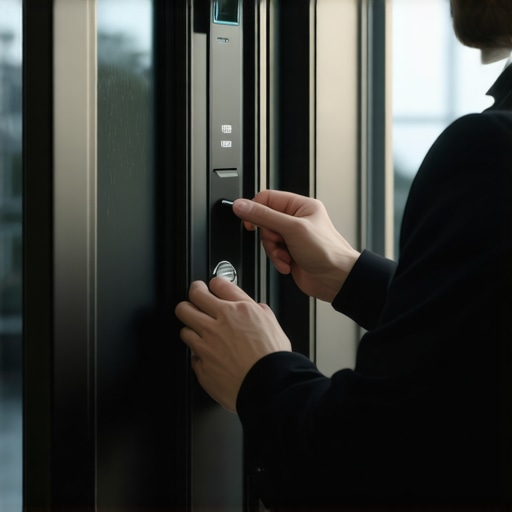
The Psychology of the Entry Point: Why Biometrics Fail Without Physics
Most homeowners in 2026 think they are buying a fortress when they pick up a high-tech biometric lock from a big-box retailer. They see the glowing LED rings and the promise of smartphone integration and think they have solved the security equation. As a locksmith who has spent over two decades smelling brass shavings and listening to the click of a setting wafer, I can tell you that a biometric scanner is only as good as the physical deadbolt it controls. Burglars do not usually try to hack your 256-bit encryption; they look for the weak strike plate or the soft wood of the door frame. If the underlying hardware is Grade 3 zinc junk, your fancy fingerprint reader is just a decorative paperweight. Real security starts with the physics of the door, not the software on your phone.
“Security is always a trade-off between convenience and protection.” – Industry Axiom
I teach my apprentices that if you have to force the key, you have already lost. This technical wisdom applies double to smart locks and biometric systems. If the motor in your new 2026 smart lock has to struggle to throw the bolt because the door is misaligned, the electronic components will fry within six months. I have seen countless DIYers burn out expensive units because they did not understand the resistance levels of a standard throw. You should be able to operate the mechanism with the tip of your pinky finger. If there is friction, there is a failure in the geometry of the installation. We are going to break down the actual mechanics of installing these units so they last until 2036, not just through next Tuesday.
The Anatomy of a High-Security Biometric Setup
When we analyze a biometric lock, we are looking at two distinct systems working in a forced marriage. First, you have the capacitive sensor or the 3D depth-sensing optical scanner. This part of the lock measures the electrical discharge between the ridges of your finger or the subsurface vascular patterns in your palm. It is sophisticated, but it is just a switch. The second system is the mechanical actuator. This is where the real work happens. Inside the housing, a tiny motor spins a series of plastic or metal gears to move the tailpiece. This tailpiece must rotate exactly 90 or 180 degrees to extend the bolt into the strike box. If the bolt meets resistance, the motor draws more current, the PCB heats up, and the logic board eventually fails. This is why material science matters. We look for locks that use hardened steel inserts in the bolt to prevent sawing and solid brass cylinders for the manual override.
Step 1: Structural Audit and Door Reinforcement
Before you even unbox the biometric unit, you must look at the door itself. Most residential doors are held together by 3/4-inch screws that barely bite into the soft pine of the jack stud. For 2026 doors, which are often composed of lightweight composites, this is a major vulnerability. To install a biometric lock correctly, you must first reinforce the strike side of the frame. I replace those tiny screws with 3-inch hardened steel wood screws that anchor directly into the structural 2×4 framing behind the door casing. This ensures that if someone tries to kick the door, the wood does not splinter. Furthermore, we check the door thickness. Many high-security locks for rental properties require a minimum of 1-3/4 inches. If your door is thinner, the internal spindle will be too long, causing the mechanism to bind. We use a caliper to check these tolerances because a difference of 1/16th of an inch can be the difference between a secure lock and a jammed one.
Step 2: The Precision Bore and Material Clearance
Most people grab a hole saw and start ripping through the door. That is how you get a loose fit that allows the lock to shift during use. A master locksmith uses a professional boring jig. We are looking for a clean 2-1/8 inch hole for the chassis and a 1-inch hole for the bolt. If the hole is slightly off-center, the tailpiece will not sit flush in the center of the bolt’s cam. This misalignment creates a lateral load on the motor. We also have to consider the backset, usually 2-3/8 or 2-3/4 inches. In 2026, many smart locks with geofencing features have larger internal footprints to accommodate the Wi-Fi and Bluetooth antennas. You must ensure the bore is deep enough so the wires can be tucked away without being pinched by the mounting plate. A pinched wire in a commercial environment is a service call waiting to happen, usually at 2 AM on a holiday.
“The strength of a lock is inversely proportional to the number of people who have a key to it.” – Security Manual Guideline
Step 3: Managing the Electronic Tailpiece and Wiring
This is where the trunk slammers always mess up. Biometric locks have a ribbon cable that connects the exterior reader to the interior battery pack and logic board. This cable is fragile. It must be routed under the bolt or through a dedicated channel in the mounting plate. If the cable is squeezed against the sharp edge of a metal door skin, the vibration from the door slamming will eventually cut the insulation, causing a short. This can lead to a lockout where the biometric scanner stops responding entirely. We use a fish tape to pull the wire through cleanly and ensure there is enough slack for the door to expand and contract with the weather. In humid climates, wood doors swell, and if your wiring is too tight, it will snap. We also check the spindle orientation. Most 2026 units use a vertical or horizontal orientation for the tailpiece depending on whether the bolt is retracted or extended. If you get this wrong, the lock will think it is locked when it is actually open.
Step 4: The Strike Box Alignment and Friction Test
The strike box is the most overlooked component of lock installation. Most people just use the flat metal plate that comes in the box. A professional uses a deep-set strike box with a dust cup. We mortise the frame so the strike plate sits perfectly flush. If the plate is proud of the wood, it can catch on the door’s weatherstripping, causing the door to not close fully. The bolt must enter the strike box without touching the sides. We use a marking paste or even a simple lipstick on the end of the bolt to see where it hits the plate. If it leaves a mark on the edge, the hole needs to be filed. The goal is zero friction. This is especially critical for locks with mobile app locksmith booking features and geofencing, as the auto-lock timer will attempt to throw the bolt when you are walking away. If it hits the plate and bounces back, your home stays unlocked while you drive to work.
Step 5: Ecosystem Integration and Fail-Safe Testing
Once the physical hardware is solid, we move to the digital layer. For 2026 doors, this means integrating with the smart home ecosystem. We calibrate the biometric sensor by having the user register their thumb and index finger from multiple angles. We also set up the geofencing parameters. This allows the lock to prepare for your arrival by waking up the sensor as your phone enters the 100-foot perimeter. We also discuss the EV car key fob replacement costs and how some modern systems allow you to use your vehicle’s NFC tag as a backup entry method. Finally, we test the manual override. Every biometric lock must have a physical keyway. We check the shear line of the bypass cylinder to ensure it is not easily pickable. I often recommend rekeying the bypass cylinder to a high-security restricted keyway so that the physical backup is as strong as the digital primary. This prevents the common scammer tactic of using a bump key on the cheap cylinders found in retail-grade smart locks.
Rekeying vs Replacing: The 2026 Verdict
I often get asked if it is better to rekey or replace. If you have a solid Grade 1 deadbolt, rekeying is almost always the smarter move. It preserves the heavy-duty housing while changing the internal pin configuration. However, when moving to biometrics, you are usually replacing the entire unit. If you are a landlord looking at high-security locks for rental properties, I suggest a modular system where the biometric reader can be replaced without changing the underlying bolt mechanism. This saves money in the long run. Also, don’t forget the basics like the key fob battery replacement guide. Even the best smart tech dies when the juice runs out. Keep a fresh 9V battery in your glovebox, as many biometric locks have external contact points for emergency power. Security is not a one-time event; it is a process of constant maintenance and technical awareness. Stay away from the zinc, stick to the brass, and never trust a lock that doesn’t have a solid strike plate.


![5 Door Lock Shield Benefits That Stop 2026 Break-Ins [Data]](https://prolocksmithco.com/wp-content/uploads/2026/03/5-Door-Lock-Shield-Benefits-That-Stop-2026-Break-Ins-Data-500x330.jpeg)