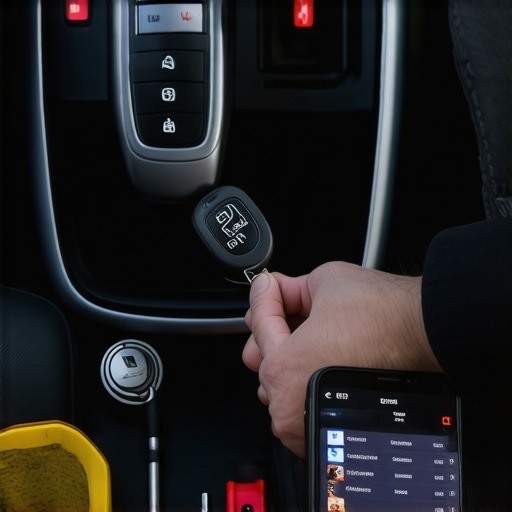
The 3 AM Reality Check: Why Your Fob Is Not Just a Plastic Toy
I once had a customer call me at 3 AM because they were stranded in a parking garage during a late-summer thunderstorm. Their keyless fob for a late-model SUV had simply stopped talking to the car. They had already called a ‘locksmith’ they found on a sponsored search result who quoted them $29 over the phone. When that guy showed up in a beat-up sedan with no branding and started talking about drilling out the ignition, the customer realized they were about to be taken for a ride. They sent him packing and called my shop. By the time I arrived, the customer was soaked and shivering, but I had them back on the road in twenty minutes without a single scratch on the vehicle. This is the reality of modern automotive security. It is not about brute force; it is about the physics of signals and the integrity of the rolling code.
“Security is always a trade-off between convenience and protection.” – Industry Axiom
When you lose a keyless fob in 2026, you are not just losing a piece of plastic with buttons. You are losing an encrypted transmitter that performs a high-speed cryptographic handshake with your vehicle’s Engine Control Unit (ECU). These fobs operate using Ultra-Wideband (UWB) frequencies and 128-bit AES encryption to prevent relay attacks. If you find yourself staring at a locked door, you need to understand the internal mechanics of what is happening before you let anyone touch your car with a tool. Most modern vehicles utilize a transponder chip embedded in the fob which, when brought near the ignition or a proximity sensor, is energized by an inductive coil. This coil creates a small electromagnetic field that powers the chip, allowing it to broadcast its unique ID. If that ID does not match the value stored in the vehicle’s EEPROM (Electrically Erasable Programmable Read-Only Memory), the fuel pump stays off and the starter remains dead. It is a digital wall, and you cannot climb it with a hammer.
The Anatomy of 2026 Automotive Transponder Keys
The 2026 updates for automotive transponder keys have made the hardware even more sophisticated. We are now seeing wider adoption of ‘Digital Keys’ stored on smartphones, but the physical fob remains the primary failsafe. These devices use ‘Rolling Codes,’ meaning the code changes every single time you press the button. A synchronized algorithm in the car knows what the next valid code should be. If a scammer tries to ‘grab’ your signal, they are grabbing a code that has already expired. This is why when you lose your fob, a real locksmith does not just ‘cut a key.’ We have to access the vehicle’s OBD-II (On-Board Diagnostics) port and use a specialized programmer to introduce the new fob’s ID to the car’s brain while simultaneously wiping the old, lost fob from the memory so no one can find it and steal the vehicle later.
Fix 1: Mobile EEPROM Programming and Lishi Extraction
The first fast recovery fix involves mobile EEPROM programming. In cases where the OBD-II port is locked or the ‘all keys lost’ scenario has bricked the system, a master locksmith will pull the module and read the data directly from the chip. This requires a steady hand and a deep understanding of circuit board architecture. While the trunk-slammers are reaching for a drill, a professional is reaching for a Lishi pick. A Lishi tool is a masterpiece of engineering that allows us to read the depths of the wafers within the emergency door lock cylinder. By feeling the resistance of the springs and the binding of the brass wafers, we can decode the mechanical bitting of the key without taking the door apart. This allows us to cut a physical emergency blade that gets us into the cabin to begin the electronic programming.
Fix 2: Precision Deadbolt Logic for the Home-to-Car Connection
Many people don’t realize that their automotive security is often linked to their home security through smart home security integration 2026 features. If your fob is lost and it was programmed with geofencing features that unlock your front door when you pull into the driveway, you have a multi-layered security breach. This is where we look at deadbolt installation DIY vs pro. A DIY person might install a smart lock but fail to realize that the strike plate is only held in by half-inch screws that will pop out with a single kick. In 2026, we are seeing smart deadbolts with fingerprint scanners that offer a secondary layer of protection. If your car is compromised, your home shouldn’t be. Professional locksmiths ensure that your garage door lock upgrades 2026 are synchronized but isolated, preventing a ‘domino effect’ of security failures. Fingerprint lock reliability tests have shown that high-end capacitive sensors are far superior to older optical ones, which can be fooled by a high-resolution photo.
Fix 3: Bypassing the Scammer Logic with Forensic Diagnostics
You need to know how to spot a scammer. A real tech uses an air wedge only to create the slightest gap for a long-reach tool, and only as a last resort. We prefer non-destructive entry. Scammers will tell you the lock is ‘high security’ and must be drilled. That is a lie 99% of the time. Even commercial panic exit devices 2026 models are designed to be serviced, not destroyed. If a tech arrives and doesn’t ask for your ID and registration before they start, send them away. They aren’t a locksmith; they are a liability. Locksmith response times 2026 averages show that a legitimate local shop can usually get to you within 30 to 45 minutes. If someone promises ’10 minutes,’ they are likely a dispatcher in another state sending an untrained sub-contractor who will fleece you.
“Standardized testing ensures that hardware meets the rigorous demands of real-world use.” – ANSI/BHMA Standard
Fix 4: Advanced Hardware Upgrades and Lock Shields
The final fix is preventative. Once we get you back into your car and program your new transponder, we often discuss lock shield installation for doors at your business or home. If you are a commercial client, we look at commercial panic exit devices 2026 that utilize antimicrobial coatings and integrated alarm sensors. For residential clients, we focus on the physics of the door frame. A smart lock with geofencing features is useless if the door can be pried open because it lacks a proper strike box. We look at the shear line of the pins—the exact point where the top pins and bottom pins meet to allow the plug to rotate. Cheap locks use zinc or pot metal pins that wear down and ‘crunch,’ whereas professional-grade locks use nickel-silver or hardened steel pins that resist both wear and picking.
Final Verdict on Modern Security
Whether it is a car fob or a fingerprint-resistant deadbolt, security is a matter of precision. The humidity in our region can swell wood doors, causing misalignments in smart locks that lead to motor burnout. A pro knows how to shim a hinge or adjust a strike plate so the bolt throws with zero friction. We don’t use WD-40, which attracts dust and turns into gunk; we use dry PTFE or silicone-based lubricants that keep the delicate springs in your fobs and locks moving freely. Don’t trust your safety to a cheap kit from a big-box store or a guy with a drill and a ‘low price’ guarantee. Real security is built on brass, steel, and encrypted logic.


![How to Cut 2026 EV Key Fob Replacement Costs by 50% [Data]](https://prolocksmithco.com/wp-content/uploads/2026/04/How-to-Cut-2026-EV-Key-Fob-Replacement-Costs-by-50-Data-500x330.jpeg)